

Investing in a Mold Is a Short-Term Cost With Long-Term Payoff
Contact us to learn how our team can advise you on the right molding solution for your engineered or industrial plastic parts application.
Advantages of Injection Molding With DPI
- Shot sizes ranging from 19 oz. up to 311 oz.
- In-house tool design and mold fabrication — single-source from concept to production
- Custom software and programming, reverse engineering, and rapid prototyping
- Heavy automation: conveyors, sprue pickers, robot arms, cooling systems, hoppers, and feeders
- Multi-cavity tooling for high-efficiency runs (one DPI product molds 32 parts per cycle in 78 seconds)
- Large-part capability: single-shot parts up to ~20 lbs. and 4′ x 4′ footprint; multi-shot assemblies over 30 lbs.
- Wall thickness up to 4″ — not a limiting factor
- In-house CNC finish-machining for tight-tolerance dimensions
Materials Used
- UHMW-PE
- Nylon
- Acetal
- Urethane
- Ultem
- PEEK
- HDPE
- Polypropylene
- Glass, carbon, and oil filled compounds
We can work with virtually any injection moldable material. Because we develop solutions primarily for industrial and high-wear applications, the materials above are what we use most often. However, if you have a specific material in mind, we’re happy to discuss whether it’s a good fit for your application.
Not sure if your part is a better fit for molding or machining? DPI’s sales and engineering teams have the experience to evaluate your part’s geometry, function, and material — and tell you honestly which process gets you the best cost and performance.
Contact A Sales Rep TodayMold It or Machine It?
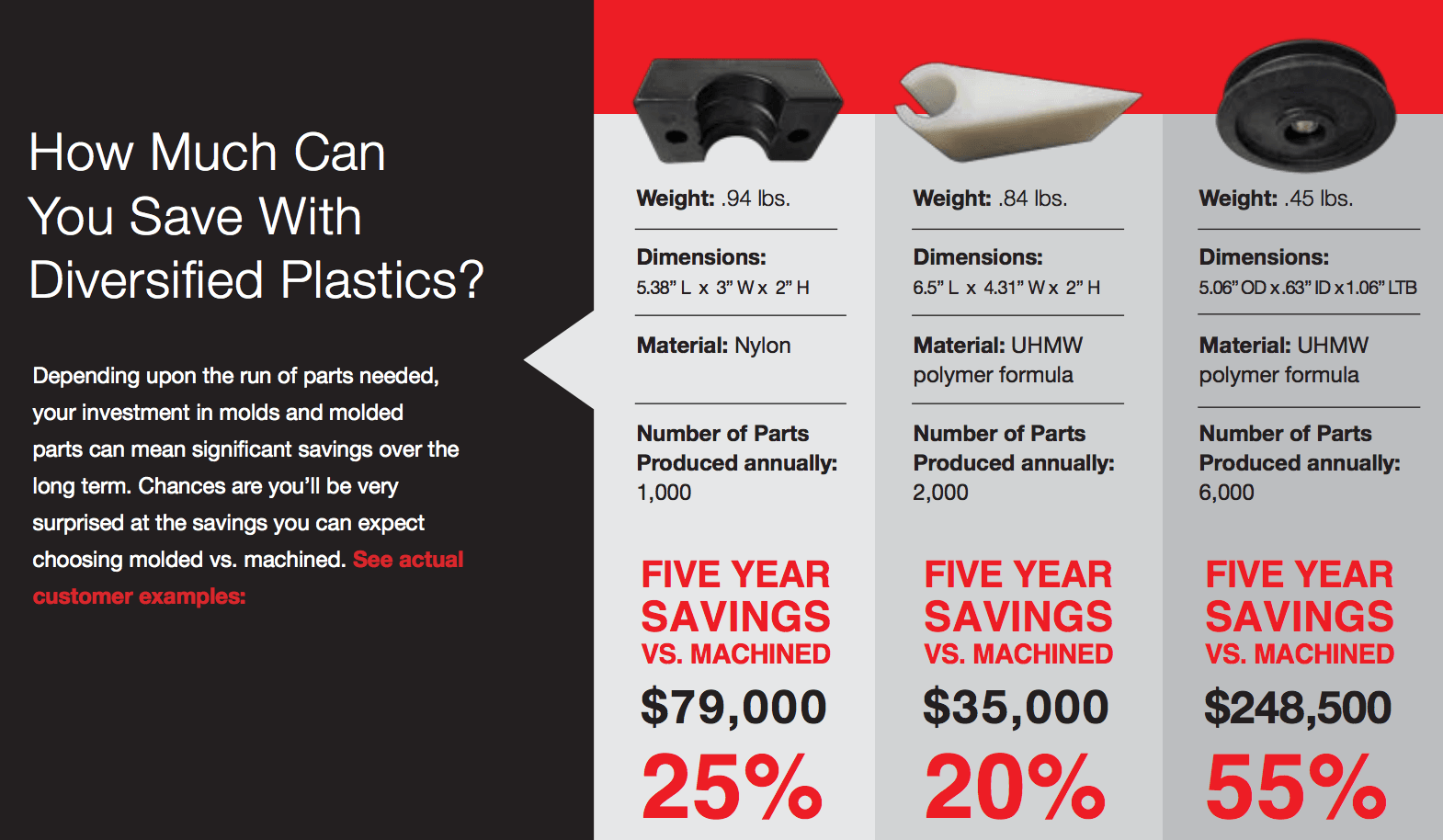
Understanding the molding process and when to utilize it can lead to big cost savings. Low- and high-volume machined replacement parts are often great candidates for molding. DPI’s sales and engineering team members have the experience and expertise to help customers identify and qualify which plastic parts and components are the best candidates to convert from machining to molding. We analyze geometry, part function, material, and possible design changes to optimize for the molding process.
Check out this comparison for real five-year savings our customers gained by converting from machining to injection molding.
Benefits of Converting to Molded Parts
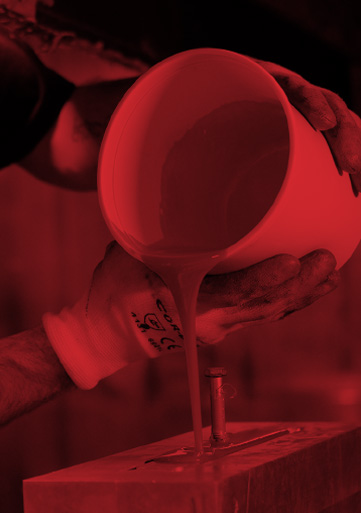
For over four decades, companies globally have trusted DPI to qualify, analyze, and define the most cost-effective method of producing their plastic components. Because machining, custom fabrication, and urethane casting all happen under the same roof, DPI can combine processes to develop solutions that couldn’t be made anywhere else. DPI also offers prototyping to test concepts, processes, and materials before committing to tooling.
Tooling cost varies by part geometry, cavity count, and material. DPI builds all tooling in-house and uses standard mold base options where possible to help control cost. Simple tooling can start around $2,500 while more complex tooling can run into the hundreds of thousands. DPI provides clear tooling costs upfront as part of any conversion evaluation.
Get a Molding Quote From a DPI EngineerIn-House Tooling and Molding Capabilities
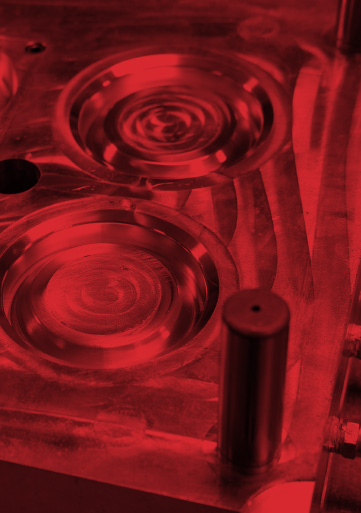
Our in-house engineering capabilities streamline development of quality, custom parts. To support your design and production needs, our process includes complete in-house tooling, molds, and fixtures; custom software and programming solutions; reverse engineering and analysis; rapid prototyping services; and collaborative on-site meetings.
Tool Room
- HAAS VF-2, 30″X 20″Y 20″Z
- HAAS VM-3, 40″X 26″Y 24″Z
- HAAS VF-6, 64″X 32″Y 30″Z
- EDM Sinker
- Small Surface Grinder
- Ejector Pin Grinder
- Knee Mill
- Horizontal Band Saw
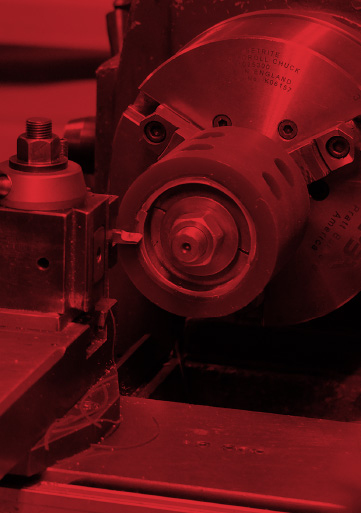
- Manual Lathe, 16″ x 60″
Molding Machines
- 19 oz / 200 ton (2000kN)
- 29 oz / 320 ton (3200kN)
- 59 oz / 380 ton (3800kN)
- 89 oz / 530 ton (5300kN)
- 143 oz / 700 ton (7000kN)
- 155 oz / 674 ton (6000kN)
- 200 oz / 800 ton (8000kN)
- 300 oz / 1200 ton (10000kN)
FAQs
We can work with virtually any injection moldable material. Our work is primarily focused on industrial and high-wear applications, so the materials we use most often include UHMW-PE, nylon, acetal, polypropylene, HDPE, polyurethane, PEEK, Ultem, and glass-, carbon-, and oil-filled compounds. If you have a specific material in mind, we’re happy to discuss whether it’s a good fit for your application.
Our largest press can produce a single-shot part weighing up to approximately 20 pounds of plastic, with footprint dimensions up to around 4′ x 4′. We also run multi-shot processes for complete parts exceeding 30 pounds. Wall thickness is not a limiting factor for us — some of our molded parts have walls up to 4 inches thick.
A few things. We design and build our injection mold tools in-house — something very few U.S. manufacturers do. That gives us better control over cost, quality, and tool longevity, and means our engineering team is deeply involved in every project from the start. We’re also able to mold extremely large and thick-walled parts that fall outside the capability range of most injection molders. And because machining, custom fabrication, and urethane casting all happen under the same roof, we can combine processes to develop solutions that simply couldn’t be made anywhere else.
Yes. We continuously automate to reduce labor and maximize throughput. Our processes incorporate automatic conveyors, sprue pickers, robot arms, cooling systems, grinders, hoppers, feeders, and packaging systems. Many production runs are set up so that machine operators aren’t required once a run is underway.
It’s one of the most efficient manufacturing processes available for plastic parts. Cycle times range from just a few seconds to around four minutes depending on part complexity, and we regularly use multi-cavity tooling to produce multiple parts per cycle. For reference, one of our higher-volume products molds 32 parts per cycle in 78 seconds. No other process can make parts that efficiently.
It varies quite a bit depending on part geometry, the number of cavities needed, and material. We build all of our tools in-house and use standard mold base options when available to help control costs. Simpler tooling can start around $2,500, while more complex tooling can run into the hundreds of thousands of dollars. We provide clear tooling costs upfront as part of any conversion evaluation.
That depends on part geometry and material. For tight-tolerance applications, we use an iterative tooling process, gradually removing material and trialing parts to dial in critical dimensions. We can also apply our in-house CNC machining capabilities to near-net-mold a part and finish-machine any dimensions that require extra precision.
 Molded Products Sell Sheet
 Injection Molding Line Card
Need Support?
When you know what you are looking for or want to start with an idea, we are ready to help. Please reach out and we will start you on your path to plastic solution success!